🎬 Series: The True Cost of Commercial Production
The RM5,000 Myth: Why Commercial Production Budgets Need a Reality Check 💸
We all know that calling a specialized plumber can easily cost RM150 just for them to walk through the door and diagnose a leak. 🔧 And if you’ve hired a professional wedding makeup artist lately, you know the standard is often RM1,000 to RM1,500 a day. 💄
Yet, when it comes to corporate marketing, it’s surprisingly common to see expectations of a full-scale commercial visual campaign being fully executed for RM3,000 to RM5,000. 😅
So, why the disconnect? It usually comes down to a simple misunderstanding between booking a “photo shoot” and funding a “commercial visual production.” One requires a single person with a camera; the other requires a coordinated operational workforce, intricate logistics, and a bulletproof strategy to create a high-ROI business asset.
If you’re a marketing executive or business owner tasked with launching a visual campaign, welcome! 👋 This series is a friendly behind-the-scenes look at where a professional production budget actually goes—starting with the most critical part of any set: The People.
The “One-Man Band” Trap 🎺
When a production is squeezed into a tiny budget, the only way to make it work is by cutting the crew.
This leaves the client with a “one-man band.” Suddenly, one human being is attempting the impossible: directing a CEO who might be feeling a bit camera-shy, dialing in complex lighting, pulling focus, monitoring exposure, checking the tethered screen, and fixing a wrinkled collar—all at the exact same time! 🤹♂️
In advertising and fashion, splitting focus like this usually means a compromised final asset. The lighting might end up flat because there was no time to sculpt it. You don’t save money by cutting the crew; you simply limit how amazing the final product can be.
Brains and Bodies: The Anatomy of a Crew 🧠💪
A smooth, professional commercial set requires two distinct layers of teamwork. You need the “brains” and the “bodies.”
The “Brains” belong to the Director of Photography (DP). They are the architect. They design the visual style, dictate the lighting ratios, and ensure the images align perfectly with your brand’s marketing strategy. 📐
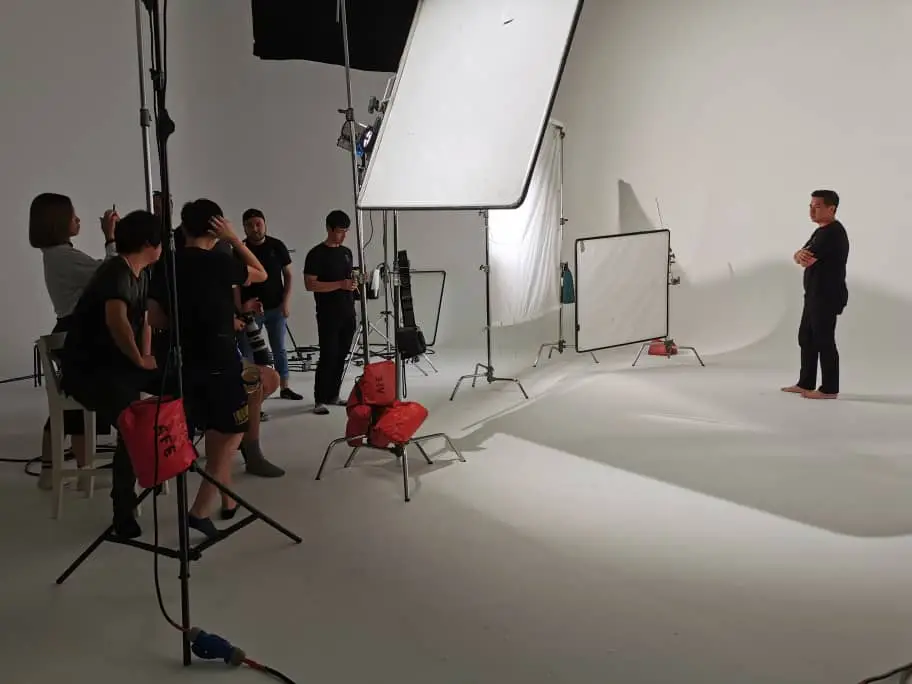
The “Bodies” are the specialized technical crew who safely and efficiently execute that vision. Running a commercial set—moving heavy lighting modifiers, running power distribution, and managing data—is intense, highly technical labor.
Here is a quick look at a standard, vetted commercial crew in our local market:
- The Cameraman / DP (RM3,000+/day): You are paying for their eye, their direction, and their ability to solve complex visual problems in real-time. 🎥
- The Lighting Assistants / Grip (RM500/day): These technicians move the heavy iron. They safely rig lights overhead and adjust modifiers in seconds so the DP never has to take their eye off the subject. 💡
- Hair, Makeup, and Grooming (RM750-RM1,000/day): A high-end camera sensor sees everything. Professional commercial HMU is absolutely essential for a polished look. 🪞
- The Digital Tech: They manage the tethering station, ensure your files are instantly backed up, and apply on-the-fly color grades so you can see exactly what the final asset will look like. 💻
The Baseline Reality 📊
When you run the math, before a single frame is captured, before the studio space is rented, and before the high-end cameras or catering are factored in, the baseline wages for a highly competent crew sit at roughly RM4,500 to RM5,000 a day.
A production budget isn’t just a markup on a photographer’s time. It is an investment in a professional workforce. 🤝 When you fund a proper crew, you are buying speed, safety, and the peace of mind that your final asset will look like an absolute industry leader.
The “Wedding Bias” & The Strategy Gap 💍
The most dangerous (and common!) phrase in corporate marketing procurement is: “But my wedding photographer only charged…” 🙈
We completely get it. For many executives or middle managers, the only time they’ve personally greenlit a major photography expense was for their own wedding. It’s totally natural to use that as a baseline!
However, there is a massive difference between event coverage and commercial visual production. Let’s break down why they are two entirely different industries. 🏗️
Documentary vs. Architecture 📸
A wedding photographer is a brilliant documentarian. They are hired to capture an event that is already happening, usually in a beautifully pre-lit, pre-built environment. Their job is wonderfully reactive—anticipating moments, emotions, and capturing them as beautifully as possible. 🥂
A commercial visual production, on the other hand, is an architectural build. We are constructing a commercial asset completely from scratch. We build the environment, we sculpt the light, we direct the talent, and we manipulate every single variable to drive specific business ROI. We aren’t capturing a moment; we are manufacturing a message. 🎯
<
The Strategy Gap 📝
Because of this “wedding bias,” organizations sometimes approach a commercial shoot without a creative brief, a mood deck, or a clear marketing direction.
By doing so, they implicitly expect the photographer to step in and act as the Creative Director, Brand Strategist, and Art Director—all on the fly! 🦸♂️ They expect the vendor to somehow invent the company’s visual identity on the morning of the shoot.
Professional budgets do not just pay for the click of a shutter; they account for vital pre-production planning. The spreadsheets, the callsheets, the location scouting, and the strategic alignment required to make the shoot successful are locked in long before the camera even leaves its case. 🧳 You are paying for the blueprint just as much as you are paying for the final house!
Heavy Iron: What Actually Eats a Production Budget 🚛
When most people imagine a “professional shoot,” they picture a very fancy camera brand or a massive, paparazzi-style telephoto lens. 📷
But here’s a fun industry secret: the camera body itself is often the least complex and least expensive logistical variable on the call sheet! In fact, top-tier commercial photographers globally command premium day rates purely for their vision and direction—without a single piece of camera equipment included in that fee. 🤯
So, what actually eats up a commercial production budget? We like to call it the Heavy Iron. ⚓
Controlling the Environment ☀️
What consumes a budget is the infrastructure required to control the environment. When we step onto a corporate set or a location, we aren’t relying on whatever ceiling lights happen to be turned on, and we certainly aren’t crossing our fingers for good weather! 🌧️ We manufacture our own consistency.
That level of control requires massive logistical support:
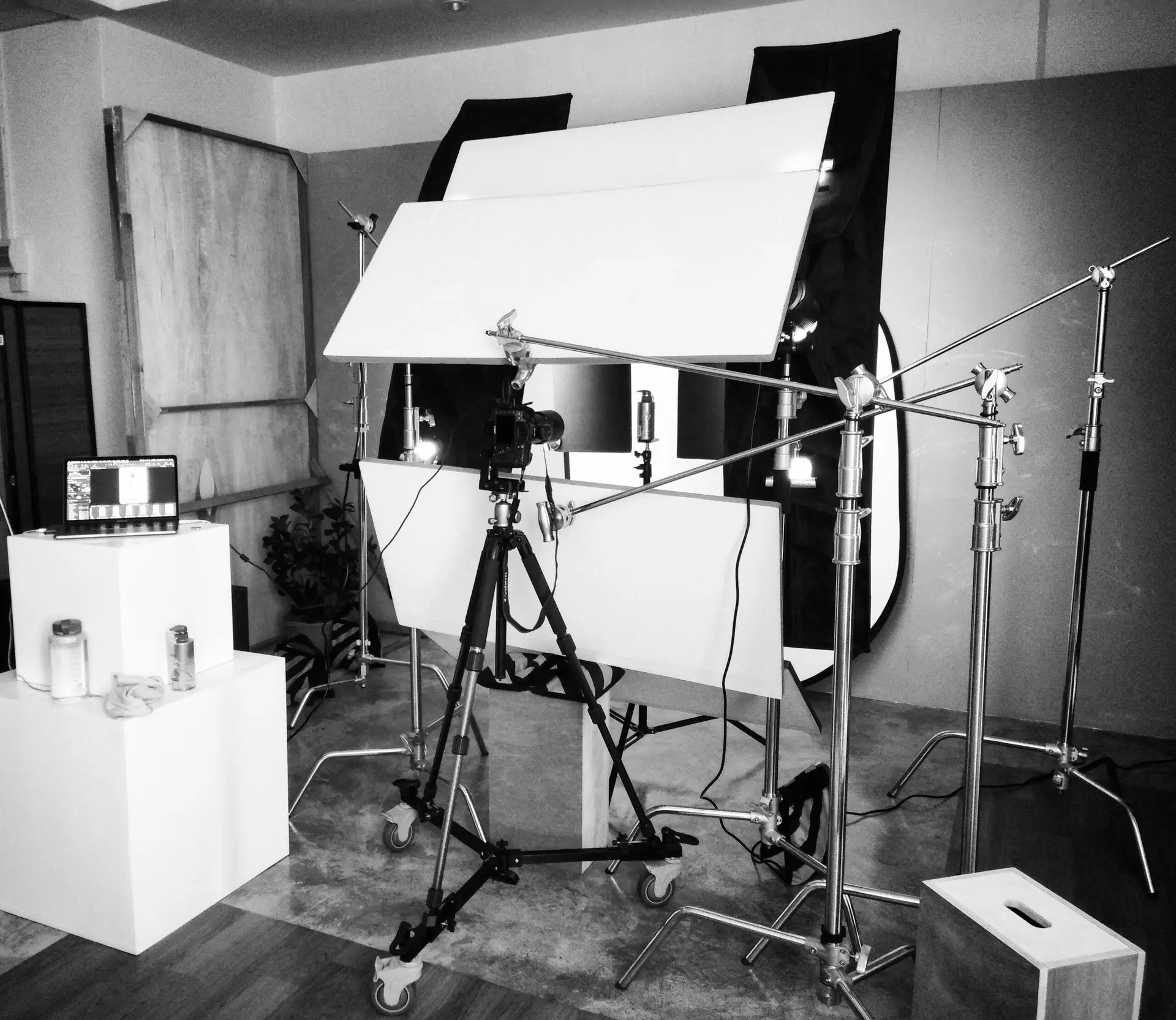
- High-Output Lighting Arrays: The cinematic lighting required to overpower the sun or illuminate massive corporate spaces. 🏟️
- Grip Equipment: Heavy-duty hardware, massive 12×12 diffusion frames, C-stands, and rolling carts to manipulate that light. ⚙️
- Mobile Power Infrastructure: Generators and professional power distribution boards so we don’t accidentally blow the circuits of your corporate headquarters! ⚡
- Transport & Logistics: Lorry transport to move tons of physical gear safely from the equipment house to your location. 🚚
The Cost of Safety 👷♂️
Beyond the rental cost of the gear itself, there is the hidden cost of safety and liability. Moving heavy equipment safely through a corporate space, a factory floor, or a public location requires specialized transport, proper setup times, and experienced crew members (grips and gaffers) who know how to rig it securely.
Cutting corners on logistics doesn’t just result in amateur-looking photos—it creates genuine operational risks. 🚨 When you pay for a professional production package, you are paying for the safety, redundancy, and infrastructure that protects your team while we get the perfect shot!
The Time Multiplier: Why Speed is the Ultimate Expense ⏳
There is an ironclad rule in commercial production: The more time you have, the less it will cost. The less time you have, the more expensive it becomes. ⏱️
Corporate executives are frequently pressured to “keep costs down.” This often leads to compressing the schedule—demanding a complex visual campaign with only one day to prep and one day to shoot, assuming that fewer days on set equals a lower invoice. 📉
The reality? It’s actually the exact opposite! Here’s why. 🏃♂️
Sequential vs. Parallel Logistics 🏗️
When you compress a schedule, you force a production to shift from sequential logistics to parallel logistics.
On a comfortable timeline, a small crew can build a scene, shoot it, tear it down, and rebuild the equipment for the next scene. Nice and easy! 😌 On a compressed timeline, you do not have the luxury of tearing down. You must build multiple setups concurrently.
This means renting twice the amount of lighting, grip, and hardware, and hiring double the manpower to manage it all at the same time so the photographer can simply step from one pre-lit set to the next. 👯♂️
The Contingency Tax 🛡️
In the commercial production world, there is no such thing as, “Sorry boss, we didn’t get the shot.” Delivery is an absolute mandate! ✅
When time is tight, you cannot afford a single mistake, a broken cable, or a sudden change in the weather. A compressed timeline means you have to pay a “contingency tax” for extreme redundancy. We rent backup equipment, hire extra hands, and keep immediate problem-solvers on set to guarantee the final asset is delivered no matter what goes wrong. 🦸♀️
The Hard Math of Overtime 🌙
Finally, there is the reality of labor hours. Production rates operate on strict, globally recognized labor tiers. Once a shoot pushes past standard hours to hit an unrealistic deadline, you aren’t just paying the base rate anymore.
The cost immediately jumps to 1.5x for the first two hours of overtime, and rockets to 3x standard rates after that. 🚀 A rushed one-day shoot can easily cost more in overtime penalties than simply planning and budgeting for a comfortable, stress-free two-day production!
The Six-Figure Pivot: When Speed Becomes the Ultimate Value 🎯
Most of the production traps we have discussed in this series apply to organizations embarking on their first real commercial visual production. But there is another tier of corporate client we love working with: The Veteran. 🥇
These are the organizations that have previously paid six-figure sums to massive creative agencies. Over time, they learned the recipe, trimmed the bloat, and assembled highly capable in-house creative teams. They know exactly how to employ a commercial photographer to execute their production without the agency markup. 📈
The Shift in Value 🔄
For these veteran teams, the definition of “value” completely flips. They do not need a photographer to build their brand strategy or act as an impromptu creative director.
They arrive on set with a locked brief, a clear mood deck, and a hard budget cap. They are buying one thing: Flawless Execution. ✨
In this scenario, a high-end commercial photographer’s premium day rate actually becomes a massive cost-saving mechanism! 💸 A veteran photographer does not waste time guessing or experimenting on set. By leveraging deep technical mastery—knowing exactly how a medium format sensor will interpret the light, or which specific modifier will solve a reflection issue instantly—the execution time plummets. 📉
Experience Equals Speed ⚡
The better the photographer, the faster the setup, the fewer the mistakes, and the lower the risk of expensive overtime.
For the in-house creative team, this means hitting their exact brief safely under their strict budget cap. The precision of the photographer maximizes the profit margin and operational efficiency for everyone involved. 🤝 When a client knows exactly what they want, the true value of a professional is the speed and perfection at which they can deliver it!
Ready to build your next visual asset? 🚀
If you are planning your next commercial campaign and want to ensure your budget is actually working for you, let’s skip the guesswork. Whether you need a full-scale crew to handle the heavy lifting, or sniper-precise execution for your in-house team, I’m here to help.
Let’s talk about your next project (or just grab a coffee! ☕)
Email Me at info@leecarmen.my ✉️
Leave a Reply